

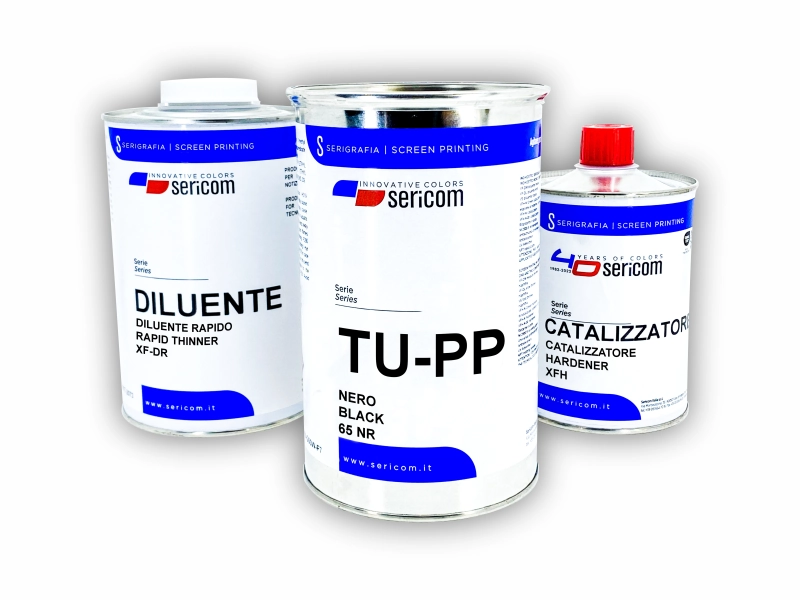
Matching the series to your product
The first step in evaluating Sericom TU-PP Series is to identify the actual substrate. Do not decide by product name alone without knowing the plastic type, metal coating or textile structure. Prepare a sample with the production substrate and record any surface treatment.
Technical data notes
Material names, ratios and times in this section are preserved from the series technical records. Do not transfer an additive ratio to another series; read each ratio together with the adjacent product code and operating conditions.
| PRODUCT SERIES | TU-PP |
|---|---|
| INK TYPE | Single- / Two-Component |
| PRINTING METHOD | Screen Printing |
| PRODUCT GROUP | Screen Printing |
| Pad Printing Ink Properties | Single- or two-component, fast-drying, glossy screen printing ink with excellent opacity. · Excellent printability. · Good solubility during printing. · Glossy appearance. · Moderate outdoor durability. · Fast drying. · Excellent opacity. · Strong adhesion to resistant substrates when the appropriate hardener is used. · Excellent chemical and physical resistance. · Pseudoplastic ink. |
| Pad Printing Ink Applications | ABS · Aluminium · Coated Paper · Lacquered Surfaces · Metals · Mylar · Polycarbonate · Polymethyl Acrylate (PPMA) · Polystyrene · Polyurethane · Rigid PVC · PVC Films · Ecoallene Requires pretreatment · PETG Requires pretreatment · Polyacetal (POM) Requires pretreatment · Polyester Requires pretreatment · Polietilen (HD-PE, LD-PE) Requires pretreatment · Polipropilen Requires pretreatment · Wood |
| Mechanical and Chemical Resistance | Alcohols Single-component · Cosmeticsler Two-component · Detergents Two-component · Petrol Two-component · Greases Two-component · Oils Two-component · Surface Hardness (Abrasion) · Water Two-component |
| Drying Properties | The ink dries physically by solvent evaporation. · Ink film thickness (single print, overprinting). · Type and quantity of thinners/retarders used. · Oven type. · Drying temperature. · Substrate material type. · 15 minutes at room temperature. · 60 sec in an air-circulation oven at 50°C. |
| Pot Life and Curing Properties | The ink and hardener mixture has a pot life of approximately 8 hours at 20°C. · High temperatures and humidity reduce pot life (a working environment of 20-25°C with low humidity is recommended). |
| Two-Component Curing by Polymerisation | When hardener is added and printing is completed, the ink first dries physically; curing occurs after 5-7 days at 20°C. · If the printed film is held in an oven at 80°C for 20 minutes, polymerisation is completed within 48 hours. |
| Outdoor Resistance | Outdoor resistance is 2 years. · Suitable for outdoor applications not exceeding 3-4 years. · The pigments used have lightfastness between 6 and 8 DIN. · For outdoor applications, use 10% XFH-N hardener. · Mixing with clear varnishes 70 TR or TP, or whites 160 or 60 BN, reduces lightfastness and weather resistance. · To improve outdoor durability, adding 5-7% UV absorber to the ink is recommended. · Fluorescent colours (see the FLUO colour chart) use special pigments whose molecular structure does not guarantee high lightfastness and which readily degrade under electromagnetic radiation. Outdoor exposure must not exceed two months. |
| Auxiliary Supplies and Additives | XFH hardener %10 · XFH-N Green hardener (*) %8 · (*) Used for outdoor applications. · For two-component use, mix with the appropriate hardener at the specified ratio before use. · Add thinner after thoroughly mixing in the hardener. · Allow the prepared ink to rest for approximately 15 minutes before printing. · VINILICO medium-speed thinner %15 · AV2 retarder %15 · XF-DR fast thinner 15 · Add thinners and retarders at a combined average of approximately 20%, according to the required drying speed. · Retarder pasta Maximum %10 · M 2000/S Conc. Stabiliser %1 · Universal Defoamer %1,5 · Antisilicone/S %1,5 · UV Adsorber %8 · NPT Matting Agent %2 (Maximum %6) · PP1 Adhesion Promoter 5% |
| Colour Range | Ink System consists of 12 basic colours used to mix RAL, Pantone and HKS colours. |
| Metallic Colours | When preparing metallic colours with TU-PP 70 TR Clear Varnish and metallic paste, use the following reference ratios: · Gold Paste 75 %10-20 · Gold Paste 76 %10-20 · Gold Paste 77 %10-20 · Bronze Paste 78 %10-20 · Silver Paste 79-050 %10-15 · Inks prepared using metallic pastes have a pot life of approximately 8 hours. |
| Process and Other Ink Colours | 1080 Yellow, 1081 Magenta, 1082 Blue, 1083 Black, TP Colour Extender Paste (CMYK) · 160 HD Opaque White · 165 HD Opak Black · 165 S Manyetik Olmayan Black |
| Certifications and Standards | CLP/GHS (EC 1272/2008), Conflict Minerals Free, EN 71-3, REACH (EC 1907/2006), RoHS · EN 71:3 applies to all standard single- and two-component inks, Ink System and process colours, HD shades and special colours, provided they are not formulated with metallic inks, metallic pastes or fluorescent pigments. |
Three separate decisions in sample preparation
| Substrate | Verify the material and any coating; do not select a series by product name alone. |
|---|---|
| Preparation | Match hardener, thinner and other additive codes to the series. Record the quantities used in the mixture. |
| Inspection timing | Plan initial appearance inspection separately from application durability testing. Drying and curing are different processes. |
Evaluate colour and durability separately
A sample close to the colour reference does not automatically meet application durability requirements. Record colour appearance, artwork clarity and required performance under use conditions as separate inspection headings. Label every sample with material details when testing the same series on different substrates.
Preparing for a technical discussion
- Sericom TU-PP Series product name and colour to be used
- Substrate raw material and coating information
- Pretreatment applied and production environment
- Required visual result and conditions the print will encounter in use